The old adage is that an author should “write what they know.” While this is great advice, it creates a bit of a sticky situation for writers of stories that take place in historical time periods or imaginary worlds. I admire my fellow craftspeople who can create magical worlds out of thin air, but I’m glad to have a plethora of historical resources available to help guide my work.
In my debut-novel-in-the-works, Collar City Gorge, I split the narrative between two historical time periods: 1860s and 1960s. Given that I was not yet born at those times, I’ve had to rely on archival sources to help me understand what life was like during those periods. I have visited museums, heritage sites and libraries—all of which are locations where I can seek out the manuscripts, photographs, artifacts and newspapers I need to piece together the storied-past.
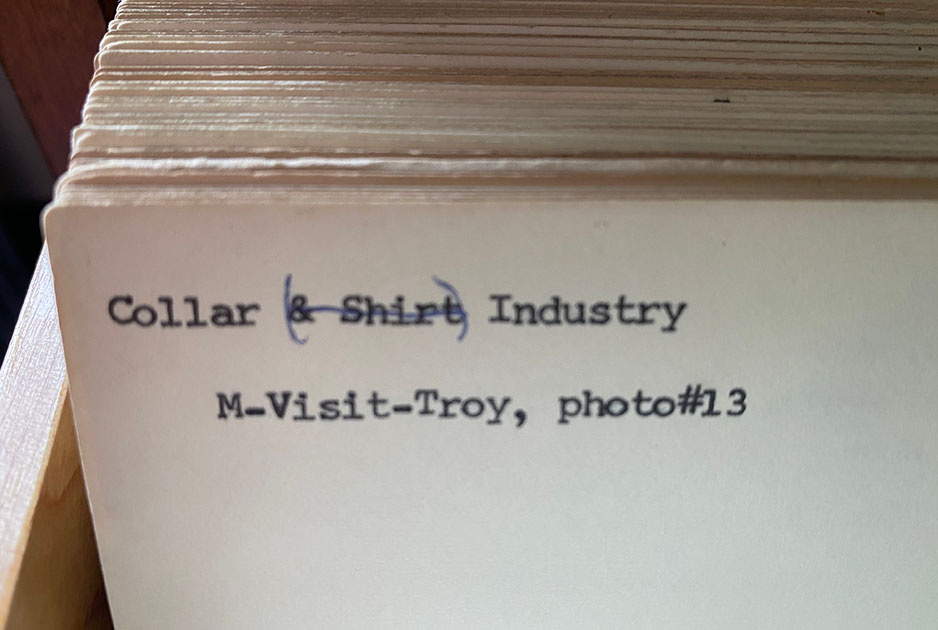
Collar City Gorge’s narrative is also split between two locations: Troy, NY and Chicago. That means I get to visit twice as many cultural sites! During the spring of 2025, I focused heavily on the history of Troy, NY and took two trips to this small Victorian town on the Hudson. The itinerary entailed visits to three museums and two libraries; it also included interviews with multiple historians and people who could provide first-hand-accounts for events-of-interest that occurred in the 1960s.


To make this type of study a success, the researcher has to be meticulously organized and, in order to read historical manuscripts, must be able to understand cursive. There is a great deal of variation in penmanship and reading dip-pen calligraphy, which has faded over time, is no easy feat! My strategy has been to focus on one collection at a time. This allows me to take notes about each person’s style—how they write a capital T or a lower-case Q for instance—which makes it easier to read through the material. When starting on a new collection, the first few documents are the hardest to decipher but, once I learn the idiosyncrasies of a person’s penmanship, the process accelerates.
By sorting through archives, I learn a number of things that can better inform a historically accurate narrative: speech patterns, common cares and concerns, weather and political climates, social practices, actual events, etc. It’s amazing how these details can help bridge connections in the plot of a novel. As I learned the history of Troy, I felt as though the book were writing itself, as if I were merely uncovering a legend that already existed there. It seemed as though these voices from the past had been waiting for someone to discover their story.
Man! You Scripts!
Reading through historic manuscripts can make you want to scream! This type of inquiry requires patience, but it is worth the wait.


In an effort to write a first draft for my acknowledgements…just kidding…in sincere gratitude, I give thanks to the following people and institutions for sharing their time, knowledge and resources with me. Without them, there would be nothing to write.
Burden Iron Works Museum; Hart Cluett Museum; Kate Mullany National Historic Site; New York State Library Cultural Education Center; Troy Public Library.
Steve Anderson; Tom Carroll; Paul Cole; Michael Oatman; Dr. Susan Ouellette; Patrick J. Quinn; Don Rittner; Kathy Sheehan; Amy Wanner Jeansonne.